Corporate layoffs and “downsizing”
The AxCorporate layoffs and “downsizing” transform the loss of a job from an individual setback into a recurring feature of economic life. The novel follows this transformation from the orderly language of corporate separation to the narrowing prospects facing experienced workers, showing how technological change and restructuring can make capable people unnecessary without making their knowledge or need for work disappear.
The Meaning and Mechanics of Downsizing
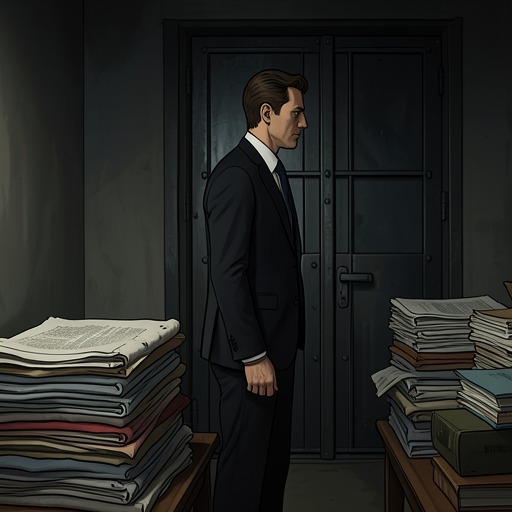
Before Burke Devore receives his dismissal notice, downsizing has already been rumored for a year or two, and two smaller rounds of staff reductions have served as preliminaries. When the yellow slip arrives with his paycheck in October 1995, the process feels businesslike and professional rather than shocking. The company presents counseling, résumé-writing instruction, and consideration of other options as a cooperative effort toward personal fulfillment. Burke recognizes the gap between that reassuring language and the underlying purpose: he is being eased out of employment, not guided toward contentment.
The delay between notice and departure gives the process a superficially humane shape. Burke remains on salary for five months, through the Christmas season, and has time to look for another job. Yet the same interval also makes the severance appear orderly and measured, as if ample preparation could soften the fact of displacement. The procedure does not eliminate the loss; it organizes it.
At Halcyon Mills, the reductions are large enough to alter the scale of the workplace. The Belial, Connecticut mill falls from 2,100 employees to 1,575, a reduction of about one-quarter. Burke’s product line is discontinued, Machine No. 11 is sold for scrap, and the work is absorbed by the company’s Canadian affiliate. In this instance, downsizing means both fewer workers and the transfer or elimination of the work around which their jobs were built.
The Worker Left to Manage the Aftermath
The apparent generosity of severance does not remove the household consequences of a lost salary. Burke has spent twenty years at Halcyon Mills, first four years as sales director and then sixteen as product manager. His package includes ten months’ pay, calculated from his years of service, and continued medical coverage for his family for four years. That protection has limits: his daughter Betsy is already nineteen and uninsured, while his son Billy’s coverage is due to end when he turns nineteen five months later. A separate payment for vacation and sick time amounts to $4,716.22, a precise figure that does little to resolve the larger uncertainty.
The novel places such individual arrangements against an increasingly unfavorable job market. A dismissed worker may initially imagine unemployment as a brief, unexpected vacation before returning to work elsewhere. But layoffs are occurring across industries, and the number of companies firing exceeds the number hiring. More displaced workers enter the search each day while the available openings grow scarcer. The problem is not simply whether an applicant is qualified; it is the worsening ratio between applicants and positions.
Burke’s experience makes that imbalance tangible. He knows the paper industry and believes he could manage nearly any job in it after minimal training in a particular specialty. Employers, however, have little incentive to train someone who is merely capable when they can recruit a person already trained for the precise function, often at lower pay and with fewer benefits. Burke sends out résumés and often receives no answer, leaving him without even the information that might explain a rejection. His expertise remains real, but it no longer assures him a place in the industry.
The search also turns ordinary professional routines into personal expenses and repeated acts of self-presentation. Applicants assemble their work histories on a résumé, buy folders and postage, make copies, and scan advertisements. Burke pays for trade journals that Halcyon Mills once supplied and studies them closely so that the industry will not move on without him. The effort reveals the contradiction at the heart of the displaced manager’s position: he is expected to remain current and competitive at the very moment that fewer employers need people with his experience.
Competition Among the Displaced
As the field of applicants grows, Burke distinguishes between people whose résumés are poorly aimed and those whose qualifications threaten his own prospects. Some applicants, in his judgment, send applications indiscriminately, while others have backgrounds and education comparable to his, or even slightly stronger. These competitors are not merely examples of a difficult market: they become the people Burke believes stand between him and a particular job. The labor market’s scarcity thus acquires a personal and increasingly dangerous meaning in his thinking.
That sense of competition is intensified by the timing of industrial layoffs. Burke identifies the paper industry’s latest downsizing as having taken place two years earlier, around the time he himself lost his job. The résumés he has collected come from workers dismissed in a relatively narrow period, from six or seven months before his layoff to six or seven months after it. They constitute a particular pool of experienced candidates, but Burke fears that the pool will grow when another round arrives. His urgency to secure a position before then is shaped by the expectation that cyclical reductions will return.
The novel also shows the logic of layoffs extending beyond manufacturing. During a conversation about an insurance policy, a representative tells Burke that his wife has been dismissed from her job as an X-ray technician after eleven years at a hospital. A health-care company from Ohio has bought the hospital and reduced its staff: six technicians are expected to do the work previously assigned to nine. Her specialized training does not make another position easy to find; placement services report more trained applicants than available work. Burke’s surprise that a hospital can be bought and treated as a commercial institution gives way to recognition that the same cutting logic reaches into health care. Downsizing is not confined to a mill or a single trade.
Automation and the Reorganization of Work
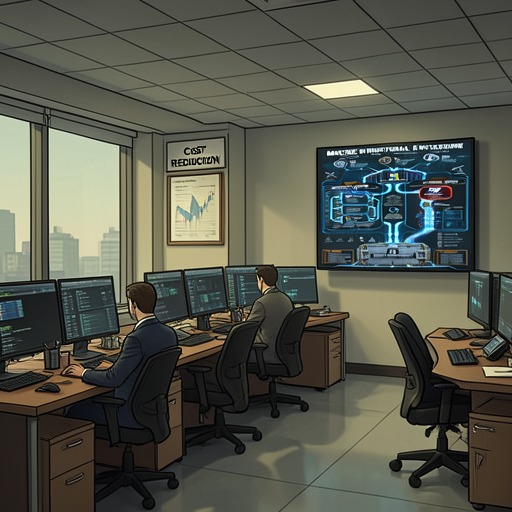
The account places contemporary white-collar reductions in a longer history of technological displacement. In the 1950s and 1960s, automation cost blue-collar workers jobs, but unions and prolonged strikes helped ease some of the transition. The newer wave falls more heavily on middle management, where workers are not unionized. The child of automation, the computer, is described as taking the place of managers and supervisors just as assembly-line robots displaced factory workers.
Middle managers had served as conduits between corporate executives and production workers. They translated orders downward and reports of accomplishment upward, while also passing information between production, suppliers, and distributors. Computer systems can take over much of this coordinating and transmitting work. A smaller number of employees may still be required to operate specific tasks, but the hundreds or thousands of managers once needed at that level are no longer considered necessary. The change is therefore not represented as a simple collapse of the company: the business can remain profitable, while the workers whose functions have been automated or consolidated are removed.
The account makes the distribution of benefits and costs part of the critique. Burke reasons that computers make managers unnecessary, facilitate mergers, and strengthen companies while increasing dividends and returns on investment. From the employer’s perspective, fewer positions are compatible with a stronger financial result; from the worker’s perspective, being fired by a company doing well makes the loss harder to understand. Middle management will not vanish entirely, but it will contract sharply. One remaining production-line job still requires a person able to communicate with workers and operate above the shop floor, yet even that surviving role is scarce enough to draw multiple experienced applicants.
Recurrence and Significance
Layoffs move through industries in waves: reductions in the automobile industry are followed by a quieter period there, then cuts in telecommunications, then computer businesses. The pattern gives unemployment a cyclical structure, but not a reassuring one. A pause in one sector does not restore the eliminated jobs, and a fresh wave can add new competitors to those already searching. For Burke, the timing of these cycles makes delay feel dangerous: he wants to establish himself before another influx of résumés arrives.
By connecting the Belial mill’s lost production line, the displaced managers’ search, and the hospital’s reduced technician staff, the novel presents downsizing as both a corporate method and a social condition. Its formal courtesies and calculations coexist with scrap machinery, vanished positions, expiring insurance, unanswered applications, and workers asked to compete for fewer openings. The term suggests a business becoming leaner; the human consequences show what that reduction leaves behind.